


Page 51 - Sixth Form Options Booklet
P. 51
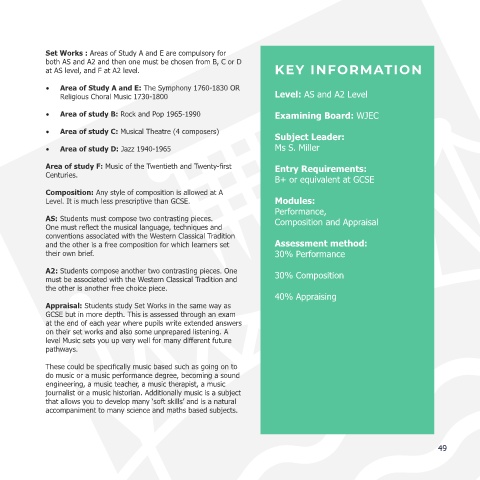
Set Works : Areas of Study A and E are compulsory for
            both AS and A2 and then one must be chosen from B, C or D
            at AS level, and F at A2 level.                          KEY INFORMATION
            •   Area of Study A and E: The Symphony 1760-1830 OR
                Religious Choral Music 1730-1800                     Level: AS and A2 Level

            •   Area of study B: Rock and Pop 1965-1990              Examining Board: WJEC
            •   Area of study C: Musical Theatre (4 composers)
                                                                     Subject Leader:
            •   Area of study D: Jazz 1940-1965                      Ms S. Miller

            Area of study F: Music of the Twentieth and Twenty-first   Entry Requirements:
            Centuries.
                                                                     B+ or equivalent at GCSE
            Composition: Any style of composition is allowed at A
            Level. It is much less prescriptive than GCSE.           Modules:
                                                                     Performance,
            AS: Students must compose two contrasting pieces.        Composition and Appraisal
            One must reflect the musical language, techniques and
            conventions associated with the Western Classical Tradition
            and the other is a free composition for which learners set   Assessment method:
            their own brief.                                         30% Performance

            A2: Students compose another two contrasting pieces. One
            must be associated with the Western Classical Tradition and   30% Composition
            the other is another free choice piece.
                                                                     40% Appraising
            Appraisal: Students study Set Works in the same way as
            GCSE but in more depth. This is assessed through an exam
            at the end of each year where pupils write extended answers
            on their set works and also some unprepared listening. A
            level Music sets you up very well for many different future
            pathways.

            These could be specifically music based such as going on to
            do music or a music performance degree, becoming a sound
            engineering, a music teacher, a music therapist, a music
            journalist or a music historian. Additionally music is a subject
            that allows you to develop many ‘soft skills’ and is a natural
            accompaniment to many science and maths based subjects.


                                                                                                              49

